Scientists
at the Institute of Molecular Biotechnology in Vienna, Austria, have grown
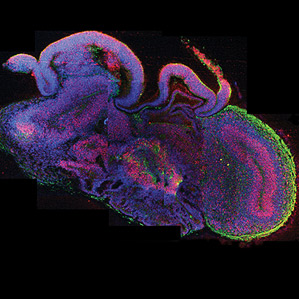
three-dimensional human brain tissues from stem cells. The tissues form
discrete structures that are seen in the developing brain.
The
Vienna researchers found that immature brain cells derived from stem cells
self-organize into brain-like tissues in the right culture conditions. The
“cerebral organoids,” as the researchers call them, grew to about four
millimeters in size and could survive as long as 10 months. For decades,
scientists have been able to take cells from animals including humans and grow
them in a petri dish, but for the most part this has been done in two
dimensions, with the cells grown in a thin layer in petri dishes. But in recent
years, researchers have advanced tissue culture techniques so that
three-dimensional brain tissue can grow in the lab. The new report from the
Austrian team demonstrates that allowing immature brain cells to self-organize
yields some of the largest and most complex lab-grown brain tissue, with
distinct subregions and signs of functional neurons.
 The
work, published in Nature on Wednesday, is the latest advance in a field
focused on creating more lifelike tissue cultures of neurons and related cells
for studying brain function, disease, and repair. With a cultured cell model
system that mimics the brain’s natural architecture, researchers would be able
to look at how certain diseases occur and screen potential medications for
toxicity and efficacy in a more natural setting, says Anja Kunze, a
neuroengineer at the University of California, Los Angeles, who has developed
three-dimensional brain tissue cultures to study Alzheimer’s disease.
The
work, published in Nature on Wednesday, is the latest advance in a field
focused on creating more lifelike tissue cultures of neurons and related cells
for studying brain function, disease, and repair. With a cultured cell model
system that mimics the brain’s natural architecture, researchers would be able
to look at how certain diseases occur and screen potential medications for
toxicity and efficacy in a more natural setting, says Anja Kunze, a
neuroengineer at the University of California, Los Angeles, who has developed
three-dimensional brain tissue cultures to study Alzheimer’s disease.
The
Austrian researchers coaxed cultured neurons to take on a three-dimensional
organization using cell-friendly scaffolding materials in the cultures. The
team also let the neuron progenitors control their own fate. “Stem cells have
an amazing ability to self-organize,” said study first author Madeline Lancaster
at a press briefing on Tuesday. Others groups have also recently seen success
in allowing progenitor cells to self-organize, leading to reports of primitive
eye structures, liver buds, and more (see “Growing Eyeballs” and “A Rudimentary
Liver Is Grown from Stem Cells”).
The
brain tissue formed discrete regions found in the early developing human brain,
including regions that resemble parts of the cortex, the retina, and structures
that produce cerebrospinal fluid. At the press briefing, senior authorJuergen
Knoblich said that while there have been numerous attempts to model human brain
tissue in a culture using human cells, the complex human organ has proved
difficult to replicate. Knoblich says the proto-brain resembles the
developmental stage of a nine-week-old fetus’s brain.
While
Knoblich’s group is focused on developmental questions, other groups are
developing three-dimensional brain tissue cultures with the hopes of treating
degenerative diseases or brain injury. A group at Georgia Institute of Technology
has developed a three-dimensional neural culture to study brain injury, with
the goal of identifying biomarkers that could be used to diagnose brain injury
and potential drug targets for medications that can repair injured neurons.
“It’s important to mimic the cellular architecture of the brain as much as
possible because the mechanical response of that tissue is very dependent on
its 3-D structure,” says biomedical engineer Michelle LaPlaca of Georgia Tech.
Physical insults on cells in a three-dimensional culture will put stress on
connections between cells and supporting material known as the extracellular
matrix, she says.
Other
researchers are developing three-dimensional brain tissue cultures to approach
fundamental questions about how the brain works. Utkan Demirci, a biomedical
engineer at Harvard Medical School and a 2006 MIT Technology Review Innovator
Under 35, reported earlier this year that microfabrication techniques enabled
his group to construct three-dimensional neuron cultures. Demirci’s lab is now
using electrical recordings and other functional studies to show that there is
synaptic activity amongst the neurons. “When you culture these cells in three
dimensions, then the arms of the neurons can extend as they do in native
tissues and build a circuit,” he says. “Once we show these are functional, we
can do a lot of interesting studies with them, including explore brain mapping
studies.”
After
confirming the success of their methods with mouse stem cells, Knoblich,
Lancaster, and colleagues used the methods to study a human developmental
genetic disorder that causes microcephaly, a condition in which brain size is
markedly reduced and is associated with severe cognitive disabilities. The team
worked with a pediatric neurologist to obtain skin cells from a patient with
microcephaly. From these cells, the team created induced pluripotent stem cells
(see “TR10: Engineered Stem Cells”). The researchers then genetically
reprogrammed these cells into primitive neurons and, with a few steps, cultured
them into a cerebral organoid in which they were able to glean hints of the
origin of the disease.
In
the future, the team would like to use the brain tissue system to study
schizophrenia and autism—cognitive disorders that are usually diagnosed in
adolescents or adults but are thought to begin in early brain development.