PLEASE make sure that you submit any missing assignments via email this week (even if you have already submitted via Dropbox) The immediacy of the student contact will allow me to fast track your assignments in the grade book as opposed to locating them in previous weeks folders.
This week we looked at our final topic: The Arts as Knowing. Due to the scope of the Arts, our initial discussion focused exclusively on the visual fine arts, such as painting and photography.
Our three main ideas include:
1. Art is a way in which humans seek knowledge from the senses;
ultimately becoming indistinguishable from one’s own mental reality.
2. Art is a scientific process and a crafted technology; one
that often results in academies, schools of thought/criticism, and cycles of
Avant Garde.
3. Art often communicates historical, ethical, iconographic,
religious, and thematic representations of “the human condition”, often
summarized in the question “what is beautiful?”
We completed the following activities in order to reinforce the main ideas of the unit:
 1. We contemplated the problem of knowledge: To what extent do humans participate in Art as both an introspective, as well as communicative, process?
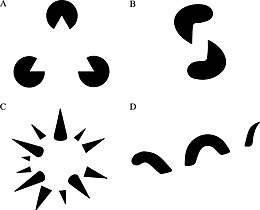
2. We looked at several simple shape illusion as a crossover to the Human Sciences (Gestalt Theory), as well as our ability to be "tricked" by our senses as a way to make meaningful/pragmatic patterns for high functionality.
3. We watched Derron Brown's experiment in "Change Blindness" and discussed how our level of observation is different in the mundane tasks of everyday life and the "sacred" nature of Art.
 4. We entered Plato's "Cave" with a drawing activity under our desks. We then attempted to learn from one another what was important from the drawings, noting challenges in interpreting other people's symbolic awareness.
 5. We looked at two paintings (one by Bosch, the other by Hitler) to determine if artistic style and subject matter can illuminate hidden psychological meaning and/or ethical character traits.
6. We observed controversial images and their ability to shape our understanding and emotions of the world. We argued whether an image (such as the "Picture of the Year" recipient from the recent Palestinian bombings) can convey an authentic, historical, and emotional meaning despite heavy editing.
We also discussed the summer assignment. Please read over the information carefully and email me with any questions.
Assignments are in the Dropbox folder.
 1. We contemplated the problem of knowledge: To what extent do humans participate in Art as both an introspective, as well as communicative, process?
2. We looked at several simple shape illusion as a crossover to the Human Sciences (Gestalt Theory), as well as our ability to be "tricked" by our senses as a way to make meaningful/pragmatic patterns for high functionality.
3. We watched Derron Brown's experiment in "Change Blindness" and discussed how our level of observation is different in the mundane tasks of everyday life and the "sacred" nature of Art.
4. We entered Plato's "Cave" with a drawing activity under our desks. We then attempted to learn from one another what was important from the drawings, noting challenges in interpreting other people's symbolic awareness. 5. We looked at two paintings (one by Bosch, the other by Hitler) to determine if artistic style and subject matter can illuminate hidden psychological meaning and/or ethical character traits.
6. We observed controversial images and their ability to shape our understanding and emotions of the world. We argued whether an image (such as the "Picture of the Year" recipient from the recent Palestinian bombings) can convey an authentic, historical, and emotional meaning despite heavy editing.
We also discussed the summer assignment. Please read over the information carefully and email me with any questions.
Assignments are in the Dropbox folder.


